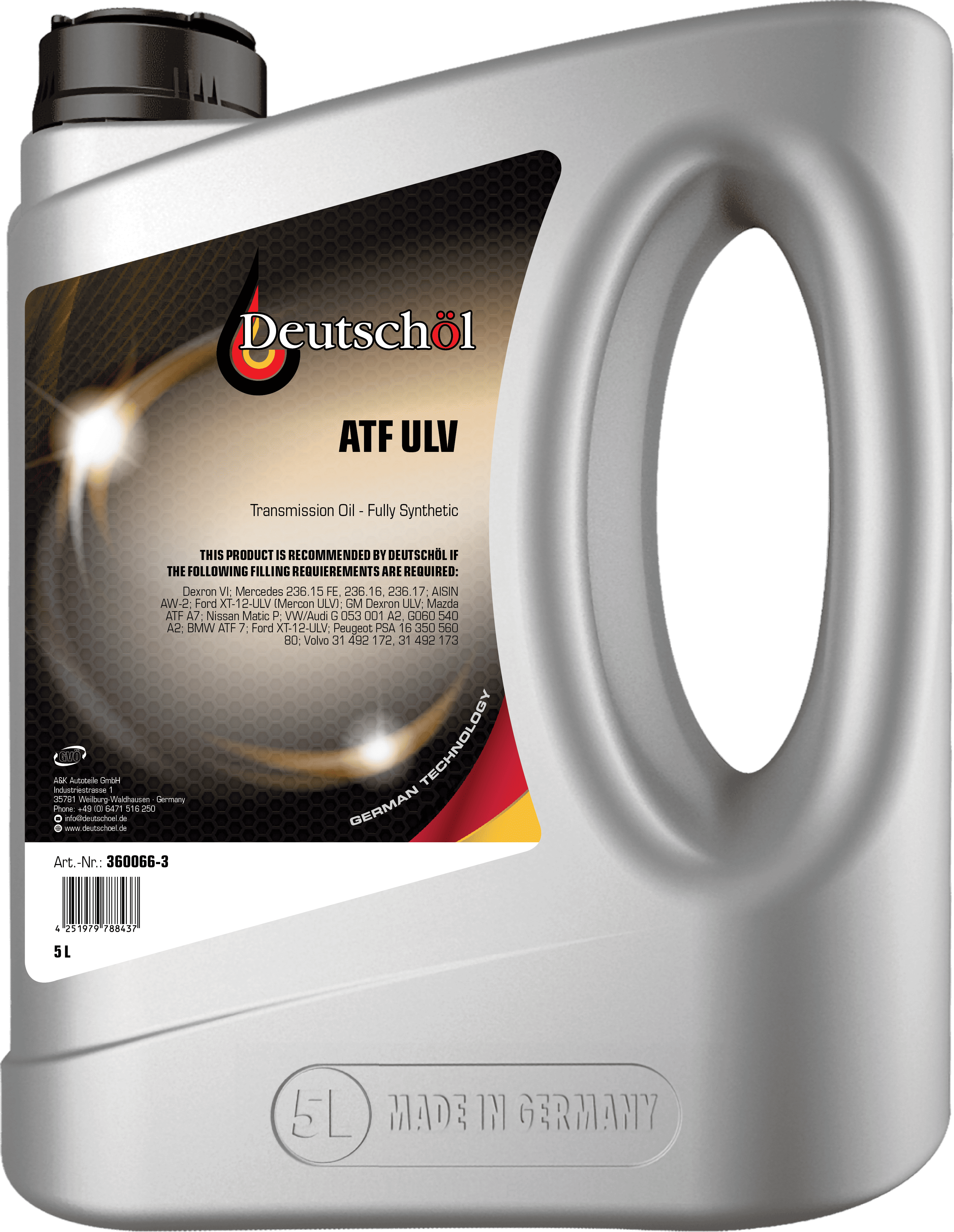
ATF ULV Ultra-Low-Viscosity Transmission Fluid

Fully synthetic ultra-low-viscosity ATF for modern transmissions requiring ULV-specific Mercedes, Ford, GM or related standards.
Viscosity grade
Ultra low viscosity
Oil type
Fully synthetic
Fluid family
Automatic-transmission fluid
Color
Transparent Amber
Item number
360066
No items found.
Description

ATF ULV is engineered for modern automatic transmissions designed around an ultra-low-viscosity fluid rather than a conventional ATF viscosity profile.

Its technical values of 22 mm²/s at 40°C and 4.7 mm²/s at 100°C support efficient fluid movement in compatible systems. The recommendation list includes Mercedes-Benz 236.15 FE, 236.16 and 236.17, Mercon ULV, Dexron ULV and selected Aisin, Mazda, Nissan, Volkswagen and BMW references.

Recommendation
Dexron VI; Mercedes 236.15 FE, 236.16, 236.17; AISIN AW-2; Ford XT-12-ULV (Mercon ULV); GM Dexron ULV; Mazda ATF A7; Nissan Matic P; VW/Audi G 053 001 A2, G060 540 A2; BMW ATF 7; Ford XT-12-ULV; Peugeot PSA 16 350 560 80; Volvo 31 492 172, 31 492 173
Available sizes
1L
5L
20L
60L
205L

ULV fluid for transmissions designed around low drag

Choose ATF ULV only when the gearbox manufacturer specifically calls for an ultra-low-viscosity fluid or one of the exact standards shown. It is not a general upgrade for older ATF systems.

Suitable applications

  • Mercedes-Benz transmissions requiring 236.16 or 236.17
  • Ford applications specifying Mercon ULV or XT-12-ULV
  • GM systems requiring Dexron ULV
  • Aisin units using AW-2
  • Selected Mazda, Nissan, Volkswagen/Audi, BMW and Peugeot transmissions

ULV is a distinct viscosity class

Do not replace a standard Dexron VI or other ATF with a ULV product unless the transmission documentation explicitly permits it.

Benefits of ATF ULV

0
1

High Wear Protection

Helps protect gears, bearings, transmission components and hydraulic parts against wear in the product’s intended application.
0
1

Controlled Friction Performance

Supports the friction behaviour required by the compatible transmission, steering or driveline system.
0
1

Transmission and System Cleanliness

Helps limit deposits so lubricated transmission, axle or hydraulic components remain cleaner during service.
0
1

Service-Interval Stability

Designed to retain reliable lubricant performance throughout the service interval permitted by the equipment manufacturer.
0
1

Efficiency Support

Uses the specified viscosity and friction profile to support efficient power transfer in compatible driveline systems.
0
1

Low-Temperature Fluidity

Supports lubricant circulation and component protection at the low temperatures shown in the technical data.

Specifications and Performance Standards

The standard set is led by current ULV requirements from Mercedes-Benz, Ford and GM, with additional Aisin, Mazda, Nissan, Volkswagen/Audi, BMW and Peugeot references.
Classification or source
Specification, standard or recommendation
Dexron specification
Dexron VI
Mercedes-Benz specification
Mercedes 236.15 FE, 236.16, 236.17
Manufacturer specification or recommendation
AISIN AW-2
Ford specification
Ford XT-12-ULV (Mercon ULV)
General Motors specification
GM Dexron ULV
Manufacturer specification or recommendation
Mazda ATF A7
Manufacturer specification or recommendation
Nissan Matic P
Volkswagen Group specification
VW/Audi G 053 001 A2, G060 540 A2
BMW specification
BMW ATF 7
Ford specification
Ford XT-12-ULV
Manufacturer specification or recommendation
Peugeot PSA 16 350 560 80
Volvo specification
Volvo 31 492 172, 31 492 173

Typical Technical Properties

A pour point below −45°C supports the product’s stated temperature performance. Typical viscosity is 22 mm²/s at 40°C and 4.7 mm²/s at 100°C.
Technical property
Typical value
Density at 15°C
0.831 g/ml
Pour point
Below −45°C
Kinematic viscosity at 40°C
22 mm²/s
Kinematic viscosity at 100°C
4.7 mm²/s
Viscosity index
136
Colour
Transparent Amber

Available Packaging Sizes

Choose from the listed pack sizes below. Availability may vary by market; contact Deutschöl for current packaging and supply information.

Why Transmission Fluid Compatibility Matters

Transmission and axle fluids influence lubrication, hydraulic control, friction engagement and heat transfer. A product that appears similar can still cause shift-quality problems, clutch chatter, synchroniser wear or seal issues when its specification does not match the unit.

Before topping up, identify the gearbox or axle code and the exact fluid already in service. Do not mix ATF, CVT fluid, DCT fluid and manual gear oil. For limited-slip axles, confirm whether an LS formulation or separate friction modifier is specified.

Use the manufacturer’s drain, filling and level-check procedure. Some transmissions require a defined fluid temperature or diagnostic sequence. If the wrong fluid may have been added, stop operation and obtain technical advice before circulation spreads it through the system.
Why Choose Deutschöl?

Deutschöl is a German lubricant brand supplying high-quality oils, coolants and maintenance products for automotive, commercial and industrial applications. The range is developed around reliable performance, recognised technical standards and the protection of engines, transmissions and equipment.

German Lubricant Expertise

Operated by A&K GmbH in Weilburg-Waldhausen, Germany, Deutschöl combines German automotive expertise with technical product support for customers, workshops and international distribution partners.

Performance and Protection

Deutschöl engine oils, hydraulic oils, industrial lubricants and coolants are formulated to support wear protection, system cleanliness, temperature stability and reliable equipment performance according to each product’s intended application.

Recognised Standards and Specifications

Products are clearly documented with relevant SAE, API, ACEA, JASO, DIN and OEM specifications where applicable, helping customers identify the correct lubricant for their vehicle, machinery or operating requirements.

FAQs

What is ATF ULV designed for?
Choose ATF ULV only when the gearbox manufacturer specifically calls for an ultra-low-viscosity fluid or one of the exact standards shown. It is not a general upgrade for older ATF systems. Do not replace a standard Dexron VI or other ATF with a ULV product unless the transmission documentation explicitly permits it.
Which specifications apply to ATF ULV?
The standard set is led by current ULV requirements from Mercedes-Benz, Ford and GM, with additional Aisin, Mazda, Nissan, Volkswagen/Audi, BMW and Peugeot references. Key entries include Dexron VI; Mercedes 236.15 FE, 236.16, 236.17; AISIN AW-2; Ford XT-12-ULV (Mercon ULV). Review the complete standards table and match the exact requirement.
What are the typical technical properties of ATF ULV?
A pour point below −45°C supports the product’s stated temperature performance. Typical viscosity is 22 mm²/s at 40°C and 4.7 mm²/s at 100°C. These are typical values rather than production specifications.
Which packaging sizes are listed for ATF ULV?
The supplied product catalogue lists 1l, 5l, 20l, 60l, 205l. Availability can vary by market and order volume, so confirm the required pack size before purchasing.
Can ATF ULV replace a regular Dexron VI fluid?
Only if the transmission manufacturer explicitly approves the ULV specification for that gearbox. Its 4.7 mm²/s viscosity at 100°C is lower than many conventional ATFs and should not be substituted by assumption.

Need Help Choosing the Right Product?

Contact the Deutschöl team for product information, technical guidance and availability enquiries.